Hypertension is known as the “silent killer” for a straightforward reason: elevated vascular pressure typically causes no headache, dizziness, or chest tightness until significant arterial or organ damage has already occurred.
Relying solely on sporadic clinic checks or occasional screenings at a crowded health center leaves dangerous diagnostic blind spots. A single clinical reading can be falsely elevated by the anxiety of a medical setting—a phenomenon known as “white-coat hypertension”—or appear deceptively normal during a quiet morning consult despite surging dangerously under work stress (“masked hypertension”).
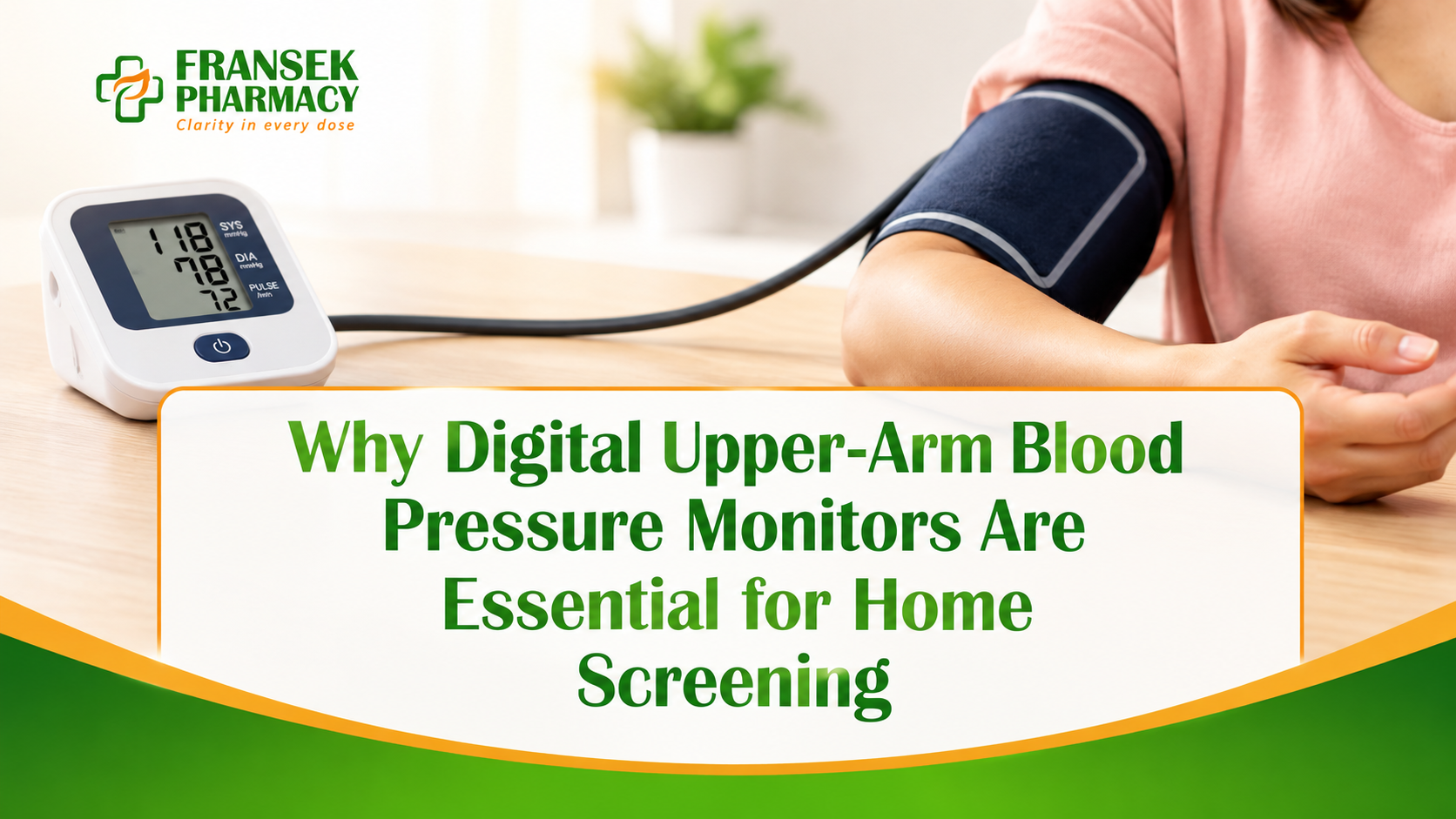
At Fransek Pharmacy, our pharmacists consider an automatic, validated blood pressure machine as fundamental to home medicine cabinets as a digital thermometer. International cardiovascular bodies (including the American Heart Association and the British and Irish Hypertension Society) consistently recommend digital upper-arm monitors as the gold standard for home diagnostic screening.
The Clinical Case: Upper-Arm vs. Wrist and Finger Monitors
Patients often ask why they should choose a bulkier upper-arm cuff over a compact wrist unit or smart wearable. The answer comes down to cardiovascular anatomy and hydrostatic pressure.
                    ┌─────────────────────────────────┐
                    │ Accuracy in Blood Pressure      │
                    │ Measurement                     │
                    └────────────────┬────────────────┘
         ┌───────────────────────────┴───────────────────────────┐
         ▼                                                       ▼
  Brachial Artery (Upper Arm)                            Radial Artery (Wrist)
  • Single large, deep vessel                            • Narrower, superficial vessels
  • Sits naturally level with the heart                  • Highly sensitive to hand position
  • Matches clinical validation standards                • Overestimates systolic pressure
1. Vessel Caliber and Depth
An upper-arm monitor occludes the brachial artery, a substantial, stable vessel carrying systemic blood flow directly from the aorta. Wrist monitors measure the radial and ulnar arteries, which are narrower, more superficial, and prone to peripheral vascular resistance, arterial stiffening, and calcification—especially in older adults or individuals with diabetes.
2. The Hydrostatic Leveling Problem
For any blood pressure measurement to be clinically valid, the sensor must sit level with the right atrium of the heart:
- Upper Arm: When sitting upright with your arm resting on a dining table or desk, the bicep cuff naturally rests at heart level.
- Wrist Units: If the wrist drops just 10 cm below heart level, gravity artificially inflates the recorded pressure by roughly 7 to 8 mmHg. Conversely, elevating the wrist too high yields an artificially low reading.
How Digital Oscillometric Monitors Function
Modern home monitors do not require a stethoscope. Instead of listening for Korotkoff sounds as a physician does with an analog sphygmomanometer, digital units employ oscillometric technology.
As the automated cuff slowly deflates, blood begins pulsing through the compressed brachial artery, creating minute oscillations (vibrations) against the cuff’s inner bladder. Highly sensitive internal transducers detect these pressure wave variations:
- The electronic sensor identifies the point of maximal oscillation, calculating the Mean Arterial Pressure (MAP).
- Built-in algorithms extrapolate the precise Systolic Pressure (peak contraction) and Diastolic Pressure (resting vascular tone).
- The device simultaneously calculates the pulse rate and screens for irregular cardiac rhythms (arrhythmias or atrial fibrillation).
Feature Comparison: Choosing the Right Home Monitor
Not all digital monitors are built for the same patient needs. When browsing medical diagnostics, evaluate these technical tiers:
| Feature / Tier | Basic Entry-Level Unit | Mid-Range Clinical Unit (Recommended) | Advanced Connected Unit |
| Measurement Method | Oscillometric | Oscillometric with dual-check sensor | Oscillometric with AFib detection |
| Cuff Design | Standard soft nylon cuff (requires manual wrap) | Pre-formed cylindrical contour cuff | Wide-range 360° precision cuff |
| Memory Capacity | 14 – 30 single-user readings | Dual-user memory (60 – 100 readings each) | Multi-user + Unlimited Cloud Sync |
| Arrhythmia Sensor | Irregular heartbeat indicator | Irregular heartbeat + movement sensor | Atrial Fibrillation (AFib) screening |
| Best Suited For | Occasional checks; younger adults | Daily chronic hypertension management | Detailed physician tracking; telehealth |
Pharmacist’s Protocol: The “Rule of Twos” for Accurate Readings
An accurate monitor will still yield misleading numbers if used incorrectly. Follow this clinical preparation routine:
  5 Minutes Rest        Arm at Heart Level       Record 2 Readings
(No caffeine/tobacco)   (Supported on table)     (1 minute apart)
         │                       │                       │
         ▼                       ▼                       ▼
  [ Preparation ] ─────────► [ Positioning ] ─────────► [ Documentation ]
- Wait 30 Minutes After Triggers: Do not measure within 30 minutes of smoking, consuming caffeine, exercising, or eating a heavy meal. Empty your bladder before sitting down.
- Rest for 5 Minutes: Sit quietly in a supportive chair with both feet flat on the floor and your back supported. Do not cross your legs or talk while the machine runs.
- Correct Cuff Placement: Bare your arm (do not roll a tight sleeve over the bicep). Place the bottom edge of the cuff roughly 2 cm (two finger-breadths) above the bend of your elbow, with the air tube aligned down the center of your inner arm.
- Follow the Rule of Twos: Take two readings, spaced 1 to 2 minutes apart, both in the morning (before morning medications) and in the evening. Record the average in a logbook or smartphone app to share with your physician.
Why Source Your Diagnostic Equipment from Fransek Pharmacy?
A blood pressure reading informs critical clinical decisions: starting, stopping, or adjusting the dose of anti-hypertensive medication. Using an uncalibrated, unvalidated, or knock-off monitor from an unregulated marketplace introduces genuine medical risk.
At Fransek Pharmacy, we ensure diagnostic tools meet medical-grade standards:
- Clinically Validated Brands: We stock models verified by international diagnostic protocols (such as Omron, Microlife, and Beurer).
- Guaranteed Calibration & Warranty: Every unit is factory-calibrated, genuine, and backed by a manufacturer warranty.
- Cuff Sizing Assistance: A cuff that is too small falsely drives readings up; a cuff that is too loose drives them down. Our pharmacists help you verify whether you need a standard (22–32 cm) or large/extra-large cuff (32–42 cm) before you finalize your order.
Take Charge of Your Cardiovascular Health
Consistent, accurate home monitoring gives you and your doctor a clear, real-world picture of your cardiovascular trends. Protect your heart, brain, and kidneys with reliable diagnostic screening tools.
Invest in clinical precision for your home.
Browse Certified Digital Upper-Arm BP Monitors at Fransek Pharmacy or reach out to our pharmacy team on live chat for help selecting the right cuff size and model.