An intensely itchy, red, circular patch appears on your skin. Your immediate instinct might be to reach into the medicine cabinet for a multi-purpose tube—often labeled as a “triple-action” cream—and smear it over the rash hoping for overnight relief.
Within 48 hours, the itching might quiet down, but a week later, the rash returns with a vengeance: broader, more inflamed, and harder to clear.
At Fransek Pharmacy, our pharmacists see this clinical cycle daily. One of the most common dermatological missteps is treating a dermatophyte (fungal) infection with a strong topical steroid, or conversely, applying a basic antifungal to atopic eczema. Because both conditions present with redness, scaling, and itching, they are frequently confused—yet their treatments are diametrically opposed.
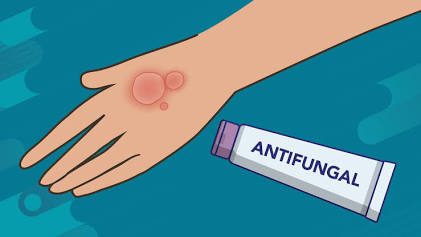
Here is an evidence-based clinical guide on how to tell a fungal rash from eczema, the hidden risks of combination steroid creams, and the correct protocol for using topical antifungals.
Ringworm vs. Eczema: How to Spot the Difference
Tinea corporis (commonly called ringworm, despite involving no actual worm) is an infection of the keratinized layer of the epidermis caused by dermatophyte fungi (Trichophyton, Microsporum, or Epidermophyton). Eczema (atopic dermatitis), on the other hand, is an autoimmune barrier dysfunction.
       [ Ringworm (Tinea Corporis) ]                [ Eczema (Atopic Dermatitis) ]
       ─────────────────────────────                ──────────────────────────────
       • Raised, serpentine border                  • Ill-defined, blurry margins
       • Central clearing ("donut" look)            • Uniform redness / leathery texture
       • Slowly expands outward                     • Symmetrical flexural creases
       • Infectious & contagious                    • Chronic, non-contagious flare
1. The Border and Margin
- Ringworm / Fungal Rash: Characterized by a sharply demarcated, raised, active border that often features tiny papules or pustules. Crucially, as the fungus consumes keratin and spreads outward in a centrifugal pattern, the center of the ring clears up, leaving a distinctive annular (“donut-shaped”) lesion.
- Eczema: The edges of an eczema flare are typically poorly demarcated and diffuse, gradually blending into normal skin without a crisp raised boundary.
2. Location and Symmetry
- Fungal Rashes: Often asymmetrical and solitary, or appearing in warm, friction-prone, moisture-trapping folds (the groin as tinea cruris, feet as tinea pedis, or under the breasts).
- Eczema: Frequently presents symmetrically on flexural creases—behind the knees, inside the bends of elbows, wrists, and ankles—with dry, lichenified (thickened) skin.
The “Triple-Action” Cream Trap: Tinea Incognito
In many community medicine cabinets, combination tubes containing an antifungal (clotrimazole/ketoconazole), an antibacterial (neomycin/gentamicin), and a potent corticosteroid (clobetasol or betamethasone) are used as universal skin salves.
Applying a strong topical corticosteroid to a fungal infection creates a condition dermatologists call Tinea Incognito:
  Fungal Lesion Formed         Steroid Blunts Immune Cells         Fungus Feeds Unchecked
 (Dermatophytes present)  ──►  (Redness & itching vanish)   ──►  (Deeper follicular spread)
- False Sense of Relief: The corticosteroid suppresses local cytokine release and vasoconstricts capillaries, causing the redness and itching to vanish within 24 to 48 hours.
- Local Immunosuppression: Steroids shut down the local cutaneous immune response—specifically the T-cell defense needed to destroy fungal hyphae.
- The Rebound Explosion: Stripped of immune surveillance, the fungus invades deeper into hair follicles and spreads wider across the skin. Once you stop the cream, the infection flares back in an aggressive, atypical form that resists standard topical therapy.
Pharmacist’s Rule: If a circular, scaly rash is suspected to be fungal, use a pure, single-agent antifungal. Never use high-potency fluorinated steroids on unconfirmed rashes.
Choosing the Right Antifungal: Azoles vs. Allylamines
When selecting an over-the-counter or prescription antifungal, the two primary pharmaceutical classes perform distinct functions:
| Class / Active Drug | Common Examples | Mechanism of Action | Typical Treatment Duration | Best Clinical Use |
| Allylamines | Terbinafine (Lamisil) | Fungicidal (Kills fungi directly by blocking squalene epoxidase) | 1 to 2 Weeks | Rapid clearance of ringworm, jock itch, and athlete’s foot. |
| Imidazoles (Azoles) | Clotrimazole, Miconazole, Ketoconazole | Fungistatic (Inhibits fungal ergosterol synthesis; stops growth) | 2 to 4 Weeks | Ideal for Candida yeast rashes, sweat rashes, and tinea versicolor. |
- Terbinafine is generally faster-acting for ringworm because it actively destroys the fungal cell wall, requiring shorter treatment durations.
- Clotrimazole / Miconazole are gentler broad-spectrum agents that effectively cover both dermatophytes and Candida yeasts (intertrigo).
The Correct Protocol: How to Apply Antifungal Creams
Applying an antifungal cream incorrectly is the leading cause of treatment failure and chronic relapse. Follow this clinical procedure:
1.Clean and Dry the Area Thoroughly:
Wash the affected skin with mild, non-perfumed soap and warm water. Pat completely dry with a clean, dedicated towel. Fungi thrive in moisture; applying cream over damp skin creates a humid microenvironment that supports fungal spore germination.
2.Treat Beyond the Visible Margin:
Do not stop at the visible red ring. Microscopic fungal hyphae extend well beyond the inflamed edge. Apply a thin layer of cream covering the entire lesion plus an additional 2 to 3 cm (about one inch) of healthy surrounding skin.
3.Massage In Gently and Leave Uncovered:
Rub the cream in until it disappears into the skin. Do not wrap the area in plastic wrap or occlusive, non-breathable dressings unless explicitly directed by a doctor, as excessive occlusion increases systemic drug absorption.
4.The 14-Day Completion Rule:
Continue applying the cream for at least 7 to 14 days AFTER all visible redness and itching have completely resolved. Fungal spores remain dormant in the stratum corneum long after visible symptoms vanish. Stopping the day the skin looks clear invites immediate relapse.
Red Flags: When to Seek Medical Evaluation
While most localized fungal patches clear smoothly with targeted topicals, certain presentations require oral prescription antifungals (such as itraconazole or fluconazole) or laboratory skin scrapings:
- Tinea Capitis (Scalp Ringworm): Fungal infections of the scalp with hair breakage, black dots, or boggy swelling (kerion) cannot be cured by topical creams alone; systemic oral antifungals are mandatory to reach the hair follicles.
- Secondary Bacterial Infection: If the lesion begins weeping honey-colored crusts, oozing thick pus, or throbbing with severe pain, a bacterial superinfection (often Staphylococcus) has developed.
- No Improvement After 14 Days: A rash that expands or fails to improve after two weeks of consistent, compliant application requires a clinical diagnosis to rule out psoriasis, nummular eczema, or granuloma annulare.
- Extensive or Widespread Spread: Fungal patches covering broad swathes of the body or occurring in diabetic or immunocompromised individuals.
Why Sourcing Skincare from Fransek Pharmacy Matters
Adulterated cosmetic creams and poorly formulated combination pastes are rampant in open markets, often spiked with unregistered clobetasol or mercury that irreparably damages the skin’s dermal architecture.
At Fransek Pharmacy, your skin’s health is safeguarded by strict quality standards:
- Single-Molecule Purity: We stock genuine, single-entity antifungal agents (Terbinafine, Clotrimazole, Ketoconazole) so you treat the underlying organism without risking steroid-induced atrophy.
- Authentic Sourcing: Every topical formulation is sourced through authorized distributor channels and verified by NAFDAC.
- Clinical Guidance: Unsure whether that dry, itchy spot is eczema, ringworm, or a sweat rash? Send a photo or consult our pharmacists via live chat for guidance before applying any treatment.
Clear Your Skin with Confidence
Stop guessing with combination creams that can aggravate fungal infections. Correct identification, proper hygiene, and completing your full course of targeted antifungal treatment are the keys to lasting relief.
Need a verified, targeted antifungal cream?
Browse Genuine Antifungal Treatments at Fransek Pharmacy or speak directly with our clinical pharmacy team on live chat for personalized skincare advice.