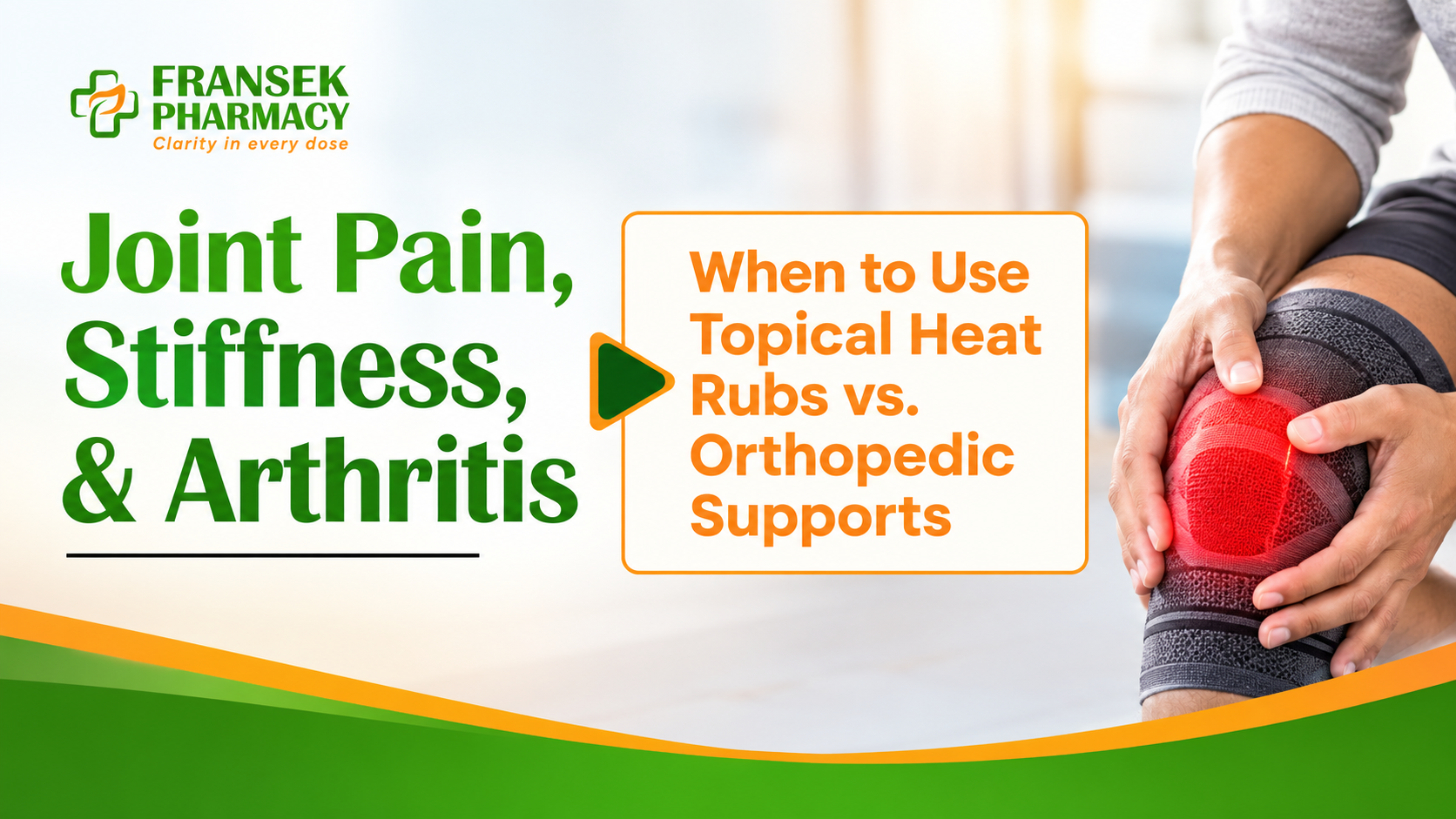
Joint pain rarely strikes in a predictable fashion. Some mornings begin with stiff, unyielding knees that take an hour of walking to loosen up. Other days, an unexpected twist, long flight, or extended walk down steep stairs brings a sharp, unstable ache that makes putting weight on the joint difficult.
When discomfort flares up, two remedies dominate home medicine cabinets: topical heat rubs and counter-irritants (balms, creams, and gels) or orthopedic supports (elastic sleeves, hinged braces, and compression wraps).
Many people use them interchangeably or incorrectly—such as applying a burning heat rub to a hot, acutely swollen joint, or wearing a rigid brace all day until surrounding muscles weaken.
At Fransek Pharmacy, our clinical team regularly guides patients through evidence-based pain management. Here is how topical thermal agents and mechanical supports work physiologically, and how to choose the right intervention for your specific joint issue.
The Physiology of Joint Deterioration: Why Joints Hurt
To treat joint pain properly, you must identify whether you are treating sensory-vascular restriction (stiffness) or biomechanical failure (instability).
                 ┌────────────────────────────────┐
                 │ Types of Musculoskeletal Pain   │
                 └───────────────┬────────────────┘
         ┌───────────────────────┴───────────────────────┐
         ▼                                               ▼
  Stiffness & Vascular Restriction             Mechanical Instability
  • Chronic Osteoarthritis                     • Cartilage Loss / Bone-on-Bone
  • Muscle Guarding & Spasms                   • Ligament Laxity (ACL/MCL)
  • Morning Immobility                         • Joint "Giving Way" Under Load
  ───────────────┬──────────────               ───────────────┬──────────────
                 ▼                                            ▼
       [ Topical Heat Rubs ]                       [ Orthopedic Supports ]
1. Chronic Osteoarthritis & Synovial Viscosity
In osteoarthritic joints, articular cartilage gradually wears down, and synovial fluid (the joint’s natural shock absorber) becomes sluggish and viscous at rest. Periarticular muscles reflexively contract to guard the joint, creating a loop of poor local blood circulation, stiffness, and dull, aching pain.
2. Structural Instability & Alignment Shifts
When cartilage degradation becomes moderate to severe, the joint space narrows unevenly (often in the medial compartment of the knee). This places abnormal mechanical torque on collateral ligaments, causing the joint to track off-center or feel like it might “give way” under weight.
When to Reach for Topical Heat Rubs
Topical rubs, balms, and liniments work through neuro-sensory modulation and local vasodilation. Common active pharmaceutical ingredients include Methyl Salicylate, Menthol, Capsaicin, and Camphor.
How They Work:
- The “Gate Control” Theory of Pain: Counter-irritants like menthol and methyl salicylate activate thermal receptors (TRPV1 and TRPM8) on sensory nerve fibers. These temperature signals travel along fast myelinated fibers to the spinal cord, effectively “closing the gate” to slower, chronic pain signals before they reach the brain.
- Micro-Vasodilation: Heat-generating balms cause cutaneous capillaries to dilate. This surges oxygenated blood into superficial tissues, speeding up the clearance of local inflammatory byproducts (such as substance P and lactic acid) and easing muscle spasms surrounding the joint.
Best Scenarios for Topical Heat Rubs:
- Morning Stiffness: Knees, wrists, or hips that feel “frozen” or stiff upon waking.
- Pre-Activity Warm-Ups: Massaging a warming balm into the periarticular muscles 15 minutes before walking or physical chores helps relax tight tendons.
- Chronic Lower Back and Neck Tension: Diffuse aching caused by postural fatigue or minor muscle spasms.
Clinical Warning from Our Pharmacists: Never apply heat rubs to an acutely inflamed, red, or hot joint (such as an acute gout flare or fresh ligament tear). Heat increases blood pooling and worsens acute swelling. In the first 48 hours of an acute injury, cold therapy (ice) is required.
When to Choose Orthopedic Supports and Braces
Unlike creams that modify pain perception, orthopedic supports alter biomechanical loads. They range from light elastic compression sleeves to rigid, hinged stabilizers.
How They Work:
- Mechanical Load Redistribution: A structured brace absorbs ground reaction forces, shifting peak pressure away from damaged cartilage compartments.
- Proprioceptive Feedback: Even a simple elastic knee sleeve compresses cutaneous mechanoreceptors, sending real-time positional data to the brain. This heightened awareness prevents awkward twisting and builds confidence during movement.
- Limiting Deleterious Range of Motion: Hinged supports mechanically stop the knee from hyperextending or bowing inward (varus/valgus stress).
Best Scenarios for Orthopedic Braces:
- Instability and “Giving Way”: Your knee or ankle feels loose or buckles under weight.
- Weight-Bearing Chores and Distance Walking: Sustained standing, market shopping, or climbing flights of stairs where mechanical protection is needed.
- Post-Sprain Ligament Protection: Stabilizing recovering collateral ligaments after a twist or athletic injury.
Direct Comparison: Heat Rubs vs. Orthopedic Supports
| Clinical Factor | Topical Heat Rubs & Balms | Orthopedic Supports & Braces |
| Primary Mechanism | Sensory counter-irritation & vasodilation | External joint stabilization & load offloading |
| Best For | Morning stiffness, muscle tension, dull ache | Instability, movement pain, cartilage wear |
| Onset of Action | Rapid (5 to 15 minutes) | Instantaneous upon proper fitting |
| Duration of Relief | Temporary (2 to 4 hours per application) | Continuous for as long as the brace is worn |
| Risk of Misuse | Skin burns if wrapped tightly under plastic | Muscle atrophy if worn 24/7 without exercise |
Can You Combine Both? The Safe Integration Protocol
You can use both modalities together, provided you observe one essential safety rule:
  Morning Heat Application        Wipe Excess & Air Dry        Fit Orthopedic Brace
(Massage balm into muscles)  ──►   (Wait 20-30 minutes)   ──►  (Avoid chemical burns)
- The Dangerous Mistake: Never apply a high-strength counter-irritant (like methyl salicylate or capsaicin) and immediately strap a tight, non-breathable neoprene brace directly over it. The trapped heat and intense occlusion can cause severe chemical burns, skin blistering, or systemic salicylate absorption.
- The Safe Clinical Method: Apply your topical rub to the surrounding muscle tissue, allowing it to fully absorb into the skin for 20 to 30 minutes. Thoroughly wipe off any excess surface residue before donning a breathable, cotton-lined or moisture-wicking orthopedic support.
- Do Not Sleep in Rigid Braces: Unless explicitly directed by your orthopedic surgeon, remove supports when sleeping. Joints need unobstructed circulation overnight, and resting in braces can cause surrounding stabilizing muscles to weaken over time.
Why Source Pain Solutions from Fransek Pharmacy?
Substandard, low-grade elastic braces quickly lose their tension after two washes, offering no real support. Similarly, unregulated pain balms frequently contain unverified chemical percentages that can cause dermal necrosis.
At Fransek Pharmacy, we prioritize safe, durable, and genuine recovery products:
- Anatomically Contoured Supports: We stock certified, breathable orthopedic braces featuring medical-grade spiral stays, silicone patellar rings, and moisture-wicking fabrics that hold their elasticity.
- Clinically Proven Topicals: Every anti-inflammatory gel, methyl salicylate balm, and capsaicin cream on our shelves is 100% genuine and NAFDAC-approved.
- Personalized Sizing Support: A brace that is too tight causes venous stasis and swelling; a loose brace slips and fails to stabilize the joint. Our pharmacists guide you through proper limb circumference measurements before you order.
Reclaim Your Comfort and Mobility
Do not let joint stiffness or instability limit your daily routine. Match your joint pain with the correct medical solution—whether targeted topical warmth, a stabilizing orthopedic support, or an integrated routine.
Take the next step toward pain-free movement.
Explore Certified Orthopedic Braces & Topical Pain Relief at Fransek Pharmacy or chat with our pharmacy team on live chat for personalized guidance on brace sizing and pain management.