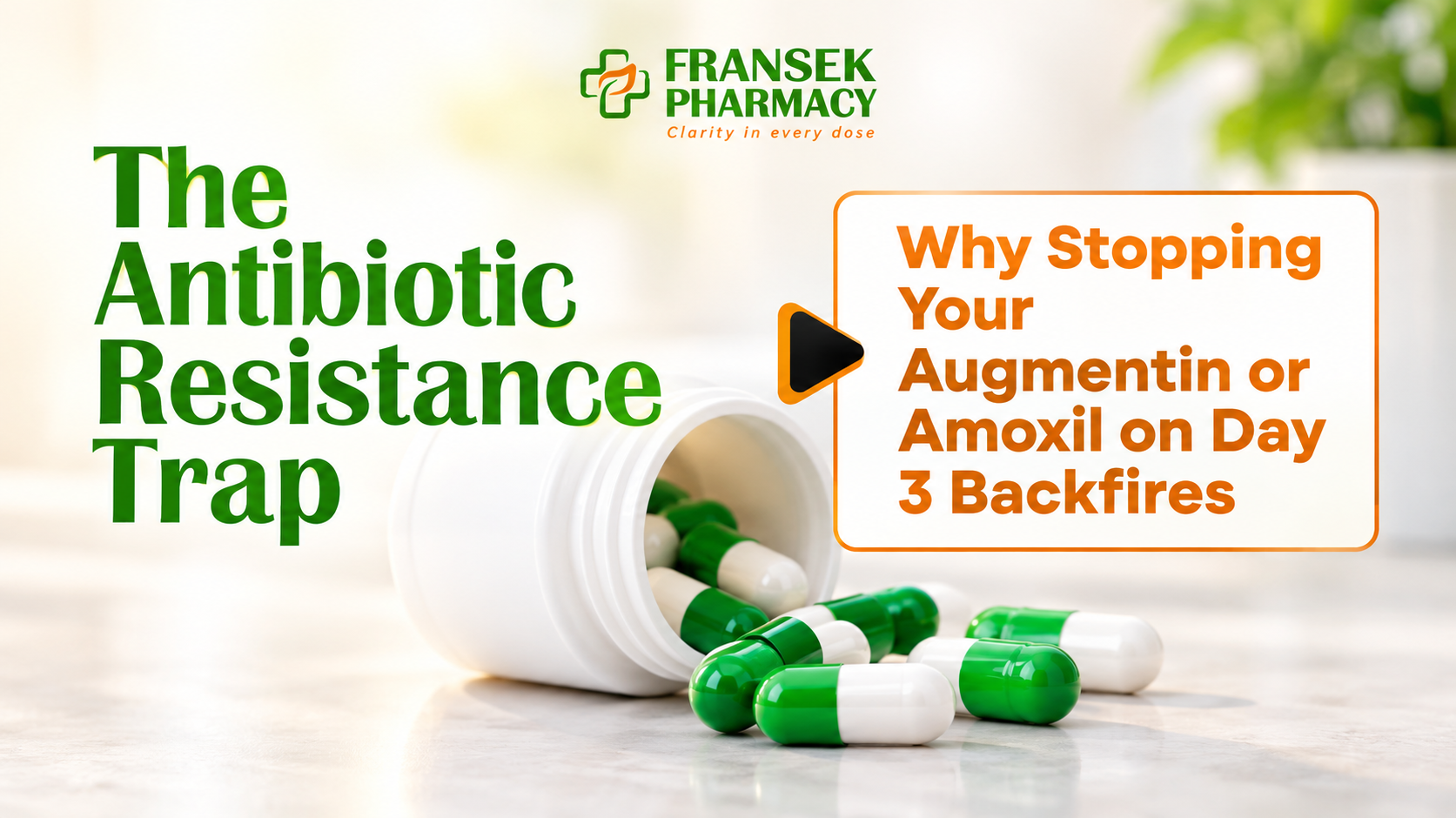
It is one of the most common scenarios in clinical outpatient practice: You wake up on a Monday with a severe bacterial throat infection, painful sinusitis, or a dental abscess. A doctor examines you and writes a prescription for a 7-day course of Amoxil (Amoxicillin) or Augmentin (Amoxicillin/Clavulanic Acid).
By Wednesday afternoon—roughly Day 3—a noticeable shift happens. Your fever breaks, the throbbing pain subsides, your appetite returns, and you feel practically back to normal.
At this exact moment, a dangerous temptation sets in: “I feel great, so why keep taking heavy drugs? I’ll save the rest in the medicine cabinet just in case.”
At Fransek Pharmacy, our dispensing pharmacists hear this reasoning every single week. Halting an antibiotic regimen prematurely is the single fastest way to trigger a secondary rebound infection and train bacteria to become completely immune to standard treatments.
Here is the underlying pharmacology of what happens inside your body when you stop taking Augmentin or Amoxil on Day 3—and why finishing every prescribed tablet protects your future health.
Bacterial Heterogeneity: Why Feeling Better Does Not Equal Being Cured
To understand why early discontinuation backfires, you have to look at an infection not as an identical clump of bacteria, but as a diverse population with varying levels of natural resilience.
       [ Day 1: Full Bacterial Load ]
       (Mix of weak, moderate, and highly resistant organisms)
                      │
                      ▼  Antibiotic initiated (Beta-lactam action)
       [ Day 3: Symptoms Disappear ]
       (Weakest bacteria eliminated; highly resistant strains survive)
         ┌────────────┴────────────┐
         ▼                         ▼
  [ STOP TREATMENT ]        [ COMPLETE COURSE ]
  • Survivors multiply      • Drug levels remain above MIC
  • Plasmids mutate         • Even stubborn strains eliminated
  • Rebound infection       • True bacterial eradication
The Bell Curve of Bacterial Susceptibility
When billions of bacteria multiply inside tissue, natural genetic variations mean some individual cells have thicker peptidoglycan walls or express small amounts of protective enzymes.
- Days 1 to 2: The therapeutic blood concentration of amoxicillin rapidly lyses the most fragile, vulnerable 70% to 80% of the bacterial colony. Because the bacterial load has dropped dramatically, your immune system cools down systemic inflammation. Your fever breaks, and you feel “cured.”
- Day 3: The only bacterial survivors remaining are the most resilient, genetically stubborn strains in the colony.
- The Trap: If you withdraw the antibiotic at this midpoint, the serum drug level plummets below the Minimum Inhibitory Concentration (MIC). The resilient survivors now have free rein to multiply in an environment completely devoid of competition.
The Resistance Mechanism: How Beta-Lactamases Work
Both Amoxil and Augmentin belong to the beta-lactam family of antibiotics. They work by binding to penicillin-binding proteins (PBPs), halting bacterial cell wall synthesis and causing the cell to burst.
However, bacteria adapt through natural selection and horizontal gene transfer:
1. The Beta-Lactamase Defense
When exposed to sub-lethal concentrations of amoxicillin (which occurs when a patient stops taking doses early), surviving bacteria upregulate plasmids that code for beta-lactamase enzymes. These enzymes physically slice open the chemical beta-lactam ring of the antibiotic, neutralizing the drug before it can harm the cell wall.
2. Why Augmentin Exists—And Why It Can Still Fail
Augmentin pairs amoxicillin with clavulanic acid (a “suicide inhibitor” that neutralizes beta-lactamase enzymes so the amoxicillin can do its job). But when Augmentin is repeatedly stopped midway through a course:
- Surviving pathogens can mutate to produce altered penicillin-binding proteins (PBPs) that neither amoxicillin nor clavulanate can latch onto.
- Bacteria can turn on active efflux pumps, which pump the antibiotic straight out of the bacterial cell as fast as it enters.
- You are left with a strain resistant not just to basic penicillin, but to broader-spectrum augmentations.
The Three Immediate Dangers of Stopping on Day 3
| Consequence | What Happens Clinically | Practical Impact on the Patient |
| 1. The Rebound Flare | Surviving resistant organisms repopulate within 5 to 10 days. | Infection returns significantly more aggressive and painful than before. |
| 2. Treatment Escalation | Amoxil or Augmentin will no longer work for the relapse. | Requires second- or third-line drugs (e.g., fluoroquinolones, cephalosporins), which carry higher toxicity risks. |
| 3. Community Spread | Resistant bacteria spread via droplets, direct contact, or food. | Family members and coworkers can catch strains that resist first-line therapy. |
Pharmacist’s Protocol: Navigating Common Antibiotic Side Effects
The primary reason patients abandon Augmentin on Day 3 is not just feeling better—it is often navigating uncomfortable gastrointestinal side effects like loose stools, stomach cramps, or mild nausea.
Clavulanic acid stimulates gastrointestinal motility directly, which frequently speeds up bowel transit times. Here is how our clinical team advises managing these issues without abandoning your prescription:
  Take at Start of Meal         Space Probiotics by 2-3 Hours       Hydrate Adequately
(Protects stomach lining)  ──►  (Preserves healthy gut flora)  ──►  (Flushes drug metabolites)
- Take with the First Bite of Food: Never take Augmentin or Amoxil on an empty stomach. Taking your dose right at the start of a meal significantly minimizes gastric irritation and maximizes absorption of clavulanate.
- Space Out Clinical Probiotics: As discussed in our gut health protocols, take a validated probiotic supplement or Saccharomyces boulardii 2 to 3 hours away from your antibiotic dose to preserve your microbiome without stopping your medication.
- Never Save “Leftover” Doses: An antibiotic course is calculated to eradicate a specific infection entirely. Three leftover tablets are useless for a future illness; using them down the road simply guarantees exposure to sub-inhibitory doses that breed superbugs.
Why Sourcing and Dispensing Matter at Fransek Pharmacy
The effectiveness of an antibiotic relies entirely on chemical purity and strict regulatory standards. Subpotent, counterfeit, or improperly stored antibiotics—frequently circulating in informal drug markets—fail to hit the required Minimum Inhibitory Concentration in your blood, driving antibiotic resistance even if you take every dose on schedule.
At Fransek Pharmacy, we maintain strict clinical governance:
- Prescription Integrity: We dispense systemic antibiotics under genuine medical prescriptions to help curb community drug resistance.
- 100% Genuine, Regulated Formulations: Our antibiotics are sourced exclusively through verified, NAFDAC-approved pharmaceutical supply chains.
- Patient Medication Reviews: Our licensed pharmacists will walk you through your exact dosing intervals (every 8 hours vs. every 12 hours) and explain how to mitigate side effects so you can complete your full course comfortably.
Protect the Power of Modern Medicine
Antibiotics are among medicine’s most precious clinical tools. Discontinuing your prescription on Day 3 might seem like a harmless shortcut, but it gives surviving pathogens an evolutionary head start. Complete your course, protect your gut flora with targeted probiotics, and help preserve critical medications for when you need them most.
Need professional guidance on your current medication regimen?
Speak with a Clinical Pharmacist at Fransek Pharmacy via live chat for dosage clarification, side-effect management, and prescription fulfillment.